A decade ago, early-stage investing in Europe looked very different from today. Many Business Angels operated primarily within regional networks. Investment opportunities often emerged through personal introductions. Cross-border investment was relatively uncommon, and information about startups travelled slowly. While successful companies certainly emerged from this environment, Europe’s investment ecosystem often remained fragmented, with founders and investors confined to national markets and disconnected networks.
Today, that picture is changing rapidly. Europe’s innovation economy has become increasingly interconnected. Startups are building products for international markets from the outset. Investors are sourcing opportunities well beyond their home regions. New funding mechanisms, digital investment platforms and harmonised regulatory frameworks are creating a more integrated European investment landscape. For Business Angels, this transformation presents both opportunities and new responsibilities. The era of the purely informal investor is gradually giving way to a more professional model of early-stage investing.
The professionalisation of angel investing
Angel investing has always involved risk, judgement and experience. Those fundamentals remain unchanged. What has changed is the complexity of the environment in which investment decisions are made. Today’s startups increasingly operate in sectors such as artificial intelligence, deep tech, health technology, biotechnology, climate innovation and advanced manufacturing. These businesses often combine scientific innovation, intellectual property, regulatory requirements and long development cycles. Assessing opportunities in these sectors requires more than entrepreneurial instinct.
As a result, many Business Angels now approach investing with a level of structure once associated primarily with venture capital funds. Portfolio thinking, formal due diligence, governance frameworks and investment theses are becoming common features of angel investment activity across Europe. This evolution benefits founders as much as investors. Better-informed investors provide more than capital. They are able to contribute expertise, challenge assumptions, support strategic decisions and help companies prepare for future financing rounds.
Why investor education matters
The increased complexity of early-stage investing has made investor education a strategic necessity rather than a nice-to-have. Many angels enter the market after successful careers as entrepreneurs, executives or industry specialists. Their experience is invaluable, but investing requires its own set of skills. Understanding valuation methodologies, shareholder structures, intellectual property protection, funding instruments, governance requirements and portfolio management is essential when building a sustainable investment practice.
Equally important is understanding how European innovation funding works. Today’s founders frequently combine multiple funding sources throughout their growth journey. Public grants, equity investment, loans, venture debt, crowdfunding, accelerator programmes and public-private co-investment schemes can all play a role in the financing strategy of a high-growth company. Investors who understand how these mechanisms interact are better positioned to evaluate opportunities and support portfolio companies throughout their development.
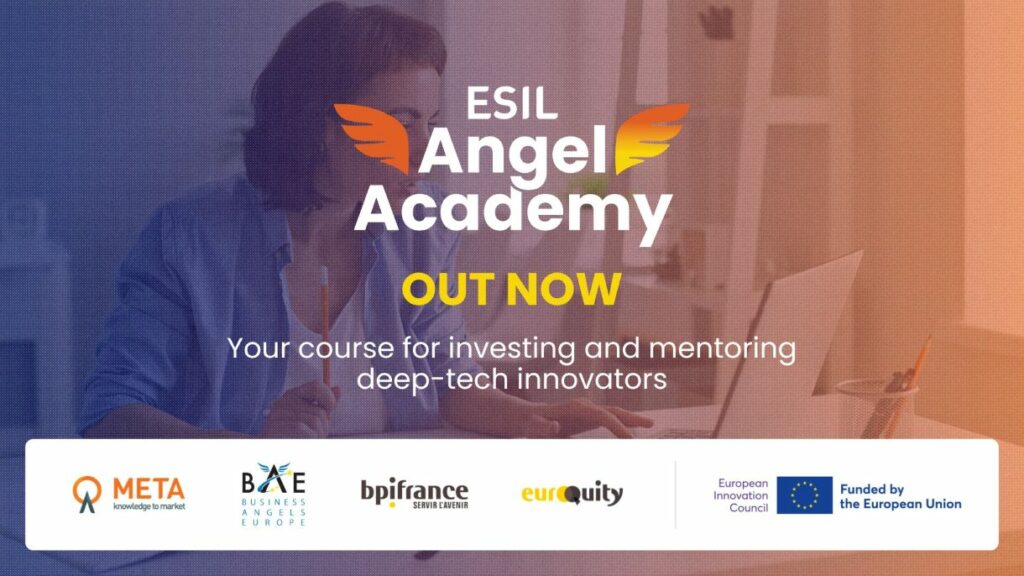
This is one of the reasons initiatives such as the ESIL Angel Academy have become increasingly relevant. The goal is not simply to teach people how to invest. It is to help create a common understanding of best practice among investors operating across Europe’s growing innovation ecosystem.
Regulation as an enabler, not an obstacle
Regulation is often discussed as a constraint on innovation. In practice, well-designed regulation is one of the key foundations that allows investment markets to scale. The development of the European Crowdfunding Service Providers Regulation (ECSPR), improvements in cross-border investment frameworks and the broader evolution of European financial regulation have contributed to a more predictable investment environment.
For founders, regulatory clarity provides greater certainty when raising capital. For investors, it reduces information asymmetries, strengthens investor protection and creates more consistent rules across jurisdictions. Understanding regulation is therefore not simply a compliance issue. It is increasingly a competitive advantage. Investors who understand the regulatory environment are often better equipped to evaluate opportunities, structure investments and identify emerging market trends before they become mainstream.
The growing role of the European Innovation Council
One of the most significant developments in Europe’s innovation landscape has been the growing role of the European Innovation Council (EIC). The EIC was established to support breakthrough technologies and high-impact innovation across Europe. Through grants, equity investments and business acceleration services, it has become one of the continent’s most important instruments for supporting deep-tech companies.
For Business Angels, the EIC represents more than a funding programme. It provides a powerful signal about the types of technologies, sectors and strategic priorities that Europe views as important for future competitiveness. Many EIC-supported companies subsequently engage with private investors to finance growth and commercialisation. Understanding how the EIC evaluates innovation therefore helps investors better understand how public and private capital increasingly work together. This interaction between public support and private investment is becoming a defining feature of Europe’s innovation ecosystem. If you like or not.
The most important shift may be that Europe is increasingly functioning as a connected investment market rather than a collection of national ecosystems. Business Angels, venture capital funds, crowdfunding platforms, accelerators, public programmes and innovation agencies increasingly operate within overlapping networks. Founders can access investors from multiple countries. Investors can identify opportunities beyond their traditional geographies. Knowledge and capital move more freely than ever before and create significant opportunities for those prepared to engage with the wider ecosystem. This also reinforces the need for common standards, continuous learning and professional investment practices.
Investing in a changing Europe
For Business Angels, Europe’s changing investment landscape should be viewed as a source of opportunity. More capital is available. More startups are emerging from research institutions and deep-tech environments. More funding pathways connect public and private investors. More tools exist to identify, evaluate and support promising businesses. At the same time, success increasingly depends on knowledge. Understanding regulation, innovation policy, investment structures and emerging funding mechanisms is becoming just as important as understanding individual companies.
The ESIL Angel Academy was created in response to precisely this challenge. By bringing together investors, ecosystem experts and organisations such as the European Innovation Council, it helps prepare angels for a market that is becoming more international, more interconnected and more sophisticated. Because while the fundamentals of investing remain the same, the environment in which investors operate is changing faster than ever.
Learn More with the ESIL Angel Academy
The ESIL Angel Academy provides practical training for aspiring and active Business Angels. Among its topics is the relationship between crowdfunding and investment evaluation, including a session by EUROCROWD on crowdfunding. Whether you’re transitioning into angel investing or simply curious about how to support high-potential innovators, this course provides a comprehensive and practical starting point.
Enrol now and start learning today: https://www.europeanesil.eu/angel-academy/
As a long-standing advocate for alternative finance and innovation funding, EUROCROWD actively supports initiatives like ESIL that strengthen the European early-stage investment ecosystem. Eurocrowd contributes to building a more accessible and efficient funding landscape, where instruments like crowdfunding can complement traditional finance and help scale Europe’s next generation of deep tech ventures. EUROCROWD has been an active partner in the early development of ESIL and supported the core partners of ESIL, META Group, Business Angels Europe and bpifrance, in the development of its activities.